Announcing the StreamShark Spatial & Immersive Video Pipeline
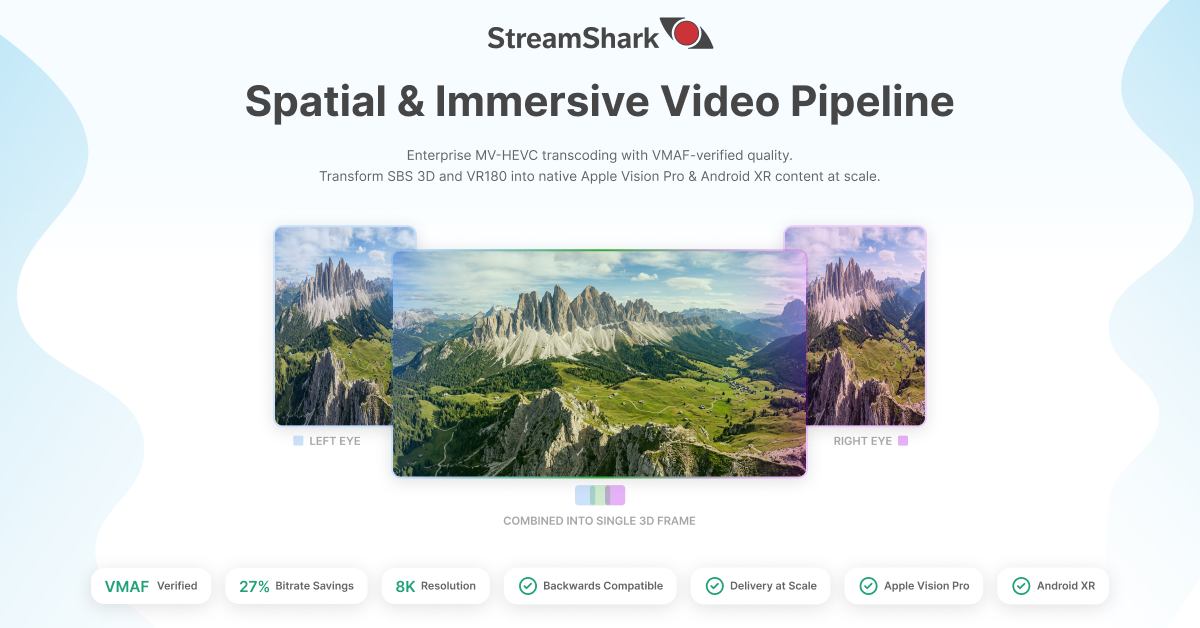
Transforming 3D content, from massive archives to active productions, into native spatial experiences for Apple Vision Pro and Android XR.
The spatial computing era is fully upon us. Headsets like the Apple Vision Pro and the latest Android XR devices feature stunning, pixel-dense displays that redefine how we experience media. But as the hardware installed base rapidly expands, the industry faces a classic chicken-and-egg problem: headset adoption relies on a compelling content library, yet shooting native spatial video from scratch can be cost-prohibitive.
Meanwhile, an enormous amount of 3D content, from classic feature films to active, modern-day VR180 sports and concert captures, is encoded in Side-by-Side (SBS) formats that today’s modern headsets cannot natively play without compromise.
Today, we are thrilled to announce the StreamShark Spatial and Immersive Video MV-HEVC Pipeline.
This enterprise-grade transcoding and quality-assurance engine bridges the format gap automatically and at scale, allowing studios, creators, and rights holders to unlock both their existing 3D archives and their current production workflows for the spatial computing era.
Evolving the SBS Workflow
For over a decade, Side-by-Side (SBS) 3D was a pragmatic standard. It packs two views into a single frame, which works well for traditional 3D displays but effectively halves the horizontal resolution that modern headset displays can render.
StreamShark completely eliminates that trade-off for spatial computing. Our new pipeline ingests both legacy and newly minted SBS 3D and VR180 media and re-encodes it into Multi-View High Efficiency Video Coding (MV-HEVC), the codec standard adopted by both Apple’s visionOS and Google’s Jetpack XR SDK.
By encoding each eye as a discrete view layer and utilizing advanced inter-view prediction to reuse shared data, StreamShark achieves bitrate savings of up to 27% compared to independent encoding, without sacrificing a single pixel of per-eye resolution.
We deliver outputs across two distinct classes, both supporting resolutions up to 8K:
- Spatial Video: For cinematic and sports content, delivering native stereoscopic 3D with full per-eye resolution.
- Immersive Video: For VR180 source material, preserving a full 180-degree field of view to completely surround the viewer.

Key Pipeline Features
We didn’t just build a transcoder; we built a comprehensive, automated delivery ecosystem designed for modern spatial demands.
1. Industry-First Native VMAF Quality Scoring
Quality assurance in spatial video has traditionally been a subjective, manual review process. StreamShark changes the game by implementing native VMAF perceptual quality scoring directly into the transcode path.
Because compression artifacts that are negligible in 2D video can cause severe viewer disorientation when they differ between eyes, our pipeline runs a per-view VMAF evaluation. It automatically flags asymmetrical compression (like blocking or detail loss) before it reaches the viewer, providing an objective, scalable quality gate for every asset.
2. Unified Cross-Platform Delivery
Reaching audiences shouldn’t mean maintaining parallel, expensive workflows for different spatial ecosystems. StreamShark’s cloud packaging layer abstracts platform fragmentation. From a single transcode output, the pipeline generates adaptive bitrate streams fully compliant with both Apple Vision Pro and Android XR playback requirements. It also includes MV-HEVC’s built-in base-layer compatibility, seamlessly falling back to a standard 2D HEVC stream for non-spatial devices.
3. Immersive Audio Pass-Through
Visual depth and 8K clarity are only half the experience. The pipeline passes through Dolby Atmos and Dolby Digital audio tracks without re-encoding, preserving the original spatial mix to ensure the complete sensory package arrives perfectly intact.
Scale Your Spatial Content Today
StreamShark removes the technical barriers and infrastructure burden of spatial video distribution. Whether you are monetizing a vast 3D back-catalog or distributing a live VR180 event shot yesterday, you can ingest a folder of SBS masters and receive compliant, high-fidelity MV-HEVC output with zero manual intervention.
It is exactly what the spatial video market needs right now: a fast, cost-effective path to building a massive, commercially viable, premium content library from the assets you already own or are creating today.
See a demo at NAB Show 2026!
The StreamShark team will be at NAB Show 2026. Come visit us to see the MV-HEVC pipeline in action and experience the stunning clarity of full-resolution spatial video for yourself.
More from the blog
Introducing Multi-DRM for VOD: Studio-Grade Protection Across Every StreamShark Endpoint
Widevine, FairPlay and PlayReady now protect your video library as well as your live events. With this release, every media endpoint on StreamShark carries the same...
When Video Isn’t Enough, Bring the Data Into the Stream
Watch a live football match and you can see what is happening on the pitch. But there is a lot more information being generated at the...

Audit Logs: Know What Changed, and Who Changed It
Audit Logs give you a searchable, filterable record of activity across your StreamShark account, in the portal and via the API. Available now for enterprise customers....
See it on your own content
Book a walkthrough of StreamShark with your own video, your own encoder and the viewers you need to reach.