Using OBS as a virtual webcam on Windows and macOS

OBS Studio has a virtual camera built in. Click Start Virtual Camera in the Controls dock, then pick “OBS Virtual Camera” as the camera in Zoom, Microsoft Teams, Google Meet or any other app, and your OBS scene shows up where your webcam would.
There is no plugin to download on Windows or macOS. The camera has shipped inside OBS since version 26 in 2020. This guide covers starting it, the settings behind the gear icon, the one approval step on a Mac, and what to do when the camera doesn’t appear.
Do I need to download an OBS virtual camera plugin?
No. The OBS-VirtualCam plugin for Windows and the obs-mac-virtualcam plugin were folded into OBS itself in versions 26.0 (September 2020) and 26.1 (December 2020). If your OBS is newer than that, the button is already in the Controls dock.
The “OBS-Camera method 1” and “method 2” zip files that still turn up in search results are copies of the old Windows plugin. Installing one alongside a current OBS gives you two cameras with the same name and a DirectShow filter that can crash the app that opens it. If you installed the old plugin years ago, remove it from Add or Remove Programs before you use the built-in one.
The one platform that still needs something extra is Linux, where the virtual camera runs on the v4l2loopback kernel module and OBS asks you to install it first.
How to start the OBS virtual camera
The steps are the same on Windows and macOS, apart from a one-time approval prompt on the Mac covered below.
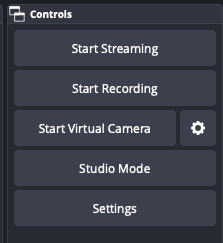
- Build the scene you want on camera. A camera source with a chroma key filter, a slide deck as a window capture with your camera in the corner, or a full lower-third layout all work; the virtual camera sends whatever the Program view shows.
- Click Start Virtual Camera in the Controls dock. The button changes to Stop Virtual Camera. OBS keeps sending frames as long as it is open, whether or not you are streaming or recording.
- Open the meeting app and pick “OBS Virtual Camera” from its camera list. In Zoom that is the arrow next to Stop Video. In Teams it is Settings, Devices, Camera. In Google Meet it is the three-dot menu, Settings, Video. If the camera isn’t listed, close the app fully and reopen it; most apps only scan for cameras at launch.
- Leave the microphone on your real mic. The virtual camera carries video only, so the meeting app still takes audio from whatever microphone it has selected.
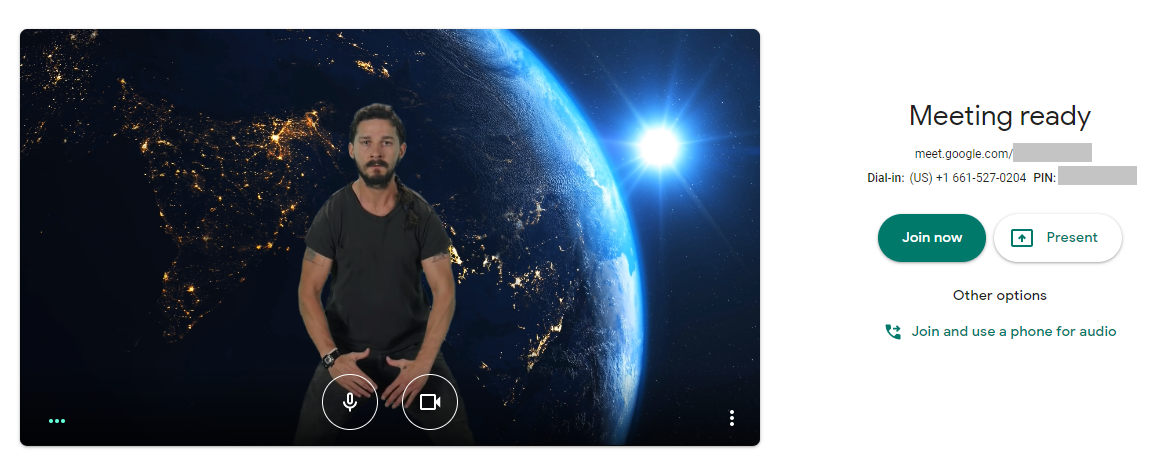
The virtual camera settings behind the gear icon
The gear next to Start Virtual Camera picks what the camera sends. Output Type has four options.
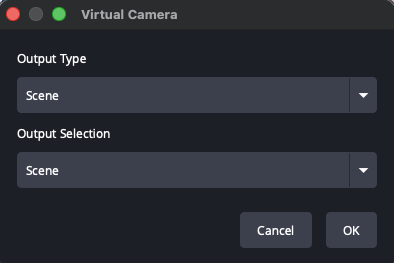
- Program is the default. The camera shows what OBS is outputting, the same picture a stream or recording would get, so scene switches and transitions show in the meeting.
- Preview sends the Preview pane in Studio Mode instead, so you can prepare the next scene while the meeting watches it. Mostly useful for checking a layout on your own before switching Program to it.
- Scene locks the camera to one named scene whatever OBS is showing. Pick a clean camera scene here and you can switch scenes for a stream without changing what the meeting sees.
- Source sends one source on its own, a single camera or a capture, at that source’s size.
A change here takes effect the next time you start the camera.
Resolution and frame rate come from the Video tab in Settings, the same Output (Scaled) Resolution and Common FPS Values the stream uses. 1280×720 at 30 fps is plenty for a meeting. Zoom, Teams and Meet downscale anything larger before it leaves your machine, so a 1080p60 canvas just costs CPU. If you also stream from the same OBS at 1080p, leave the Video tab alone and let the meeting app do the scaling.
OBS virtual camera on a Mac
On macOS the virtual camera is a system extension that macOS has to approve once. OBS 30 and later ship it this way and need macOS 13 Ventura or newer.
Update OBS before anything else. OBS’s virtual camera troubleshooting page is explicit that OBS 29.1 and earlier don’t work on macOS 14 at all.
- Click Start Virtual Camera. The first time, macOS shows a “System Extension Blocked” prompt. Click Open System Settings.
- On macOS 13 and 14, go to Privacy & Security and scroll to the Security section. On macOS 15 and later, go to General, Login Items & Extensions, Camera Extensions.
- Click Allow next to the OBS entry and enter your password.
- Quit and reopen OBS, then start the virtual camera again. It appears as “OBS Virtual Camera” in every Mac app from then on, including Safari and FaceTime.
Two cases need more than the steps above.
- A managed company Mac. A device management profile can grey out the Allow button. The IT team has to approve the extension (its identifier starts with com.obsproject) before it will run.
- macOS 11 or 12. OBS uses the older DAL plugin instead, which installs itself on the first Start Virtual Camera. It works in Chrome and Edge but not in every app, and OBS’s page recommends a Chromium browser for Discord on those versions.
OBS virtual camera on Windows
Windows needs no approval step. The installer registers the camera, and Start Virtual Camera works straight away.
If “OBS Virtual Camera” is missing from an app’s camera list after a restart, the registration didn’t happen. This is common with the portable build or when OBS was installed to a custom folder. The fix is a script that ships with OBS.
- Open the folder
C:\Program Files\obs-studio\data\obs-plugins\win-dshow, or the same path under your install. - Right-click
virtualcam-install.batand run it as administrator. - Restart the meeting app and pick the camera again. The
virtualcam-uninstall.batbeside it removes the camera if you ever need to.
Apps built on the newer Windows camera frameworks, including the Microsoft Store versions of Teams and some UWP apps, can’t see DirectShow cameras at all. For those, the desktop version of the app is the fix.
When a town hall outgrows the meeting
The virtual camera is the right tool for putting a produced picture into a meeting of a few dozen people. Once the audience is the whole company, the meeting app becomes the limit. Participant caps, everyone’s video tiles competing for bandwidth, and no way to see who watched.
The same OBS scene streams to a live streaming platform over RTMP with the settings in our OBS settings guide, and the stream reaches thousands of viewers in a player with no meeting client at all.
Running both at once is normal. The virtual camera feeds the panel’s Zoom call while Start Streaming sends the program to the wider audience.
Common questions
Why doesn’t OBS Virtual Camera show up in Zoom or Teams?
Usually because the app was open before the camera was started. Start the virtual camera, then quit the app completely (not just close the window) and reopen it.
If it is still missing, on a Mac check the extension was approved in System Settings as above, and on Windows run the install script as administrator. If the old OBS-VirtualCam plugin is still installed, remove it. Two devices with the same name confuse the picker.
Does the OBS virtual camera send audio?
No. It is video only. The meeting app keeps using the microphone selected in its own settings.
To send OBS’s mixed audio into a meeting you need a virtual audio cable such as VB-Cable on Windows or BlackHole on macOS, set as an OBS monitoring device and as the app’s microphone. That is a separate setup.
Why is my picture mirrored?
Zoom, Teams and Meet mirror your own preview and nobody else’s view, so text that reads backwards to you reads correctly to the meeting. Turn off “Mirror my video” in the app’s video settings if it bothers you; don’t flip the source in OBS, or everyone else sees it backwards.
Can I stream and use the virtual camera at the same time?
Yes. The virtual camera, the stream and the recording are independent outputs of the same program feed. Set the gear icon to Scene if you want the meeting locked to one scene while you switch scenes for the stream.
More from the blog
Live stream analytics for corporate communications, what to measure and how to check a platform can measure it
The five questions a communications team needs answered after a town hall, which metrics matter during the event and after it, and how to test a...

Why corporate live streams fail at scale, and how to design global event delivery that holds
Corporate live streams fail at one point in the path nobody planned to lose. Where those points are, and how enterprise teams design them out with...
Introducing Multi-DRM for VOD: Studio-Grade Protection Across Every StreamShark Endpoint
Widevine, FairPlay and PlayReady now protect your video library as well as your live events. With this release, every media endpoint on StreamShark carries the same...
See it on your own content
Book a walkthrough of StreamShark with your own video, your own encoder and the viewers you need to reach.